



API Development
January 19, 2026

TL;DR
CodeSpell’s built-in spells are in-IDE actions that remove friction from everyday development work. By helping teams understand code faster, document and test in flow, and clean up complexity as they build, spells turn incremental coding improvements into more predictable delivery speed without changing how teams work.
In large codebases, developers spend a disproportionate amount of time understanding existing logic, navigating undocumented decisions, and managing repetitive tasks that sit around the actual business logic. Documentation is often written late or not at all. Unit tests are added under time pressure. Refactoring is postponed because delivery deadlines take priority.
Over time, these small frictions compound. Velocity becomes uneven. Progress depends on a few people who “know the system.” Shipping faster starts to require heroic effort rather than a reliable process.
This is one of the core problem CodeSpell addresses by removing the repetitive effort that slows teams down inside the coding workflow itself.
CodeSpell’s built-in spells are purposeful, designed around how developers actually work. Instead of prompting a general-purpose AI or switching between tools, developers invoke spells directly where they are writing or reviewing code.
Each spell is:
This distinction matters. Generic AI chat tools can be helpful, but they often require extra explanation, context setup, and back-and-forth. Spells reduce that overhead by being opinionated and focused, turning common tasks into single, deliberate actions.
The goal is not to automate thinking. It is to automate the parts of coding that do not benefit from repeated human effort.
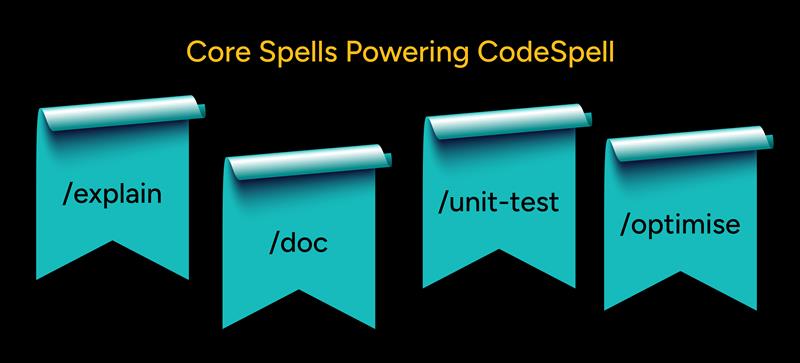
Codespell’s core spells address the most common sources of friction inside enterprise codebases.
/explain - Faster Code Understanding
Understanding existing code is one of the biggest hidden costs in software development, especially in large or long-lived systems. The /explain spell helps developers quickly understand unfamiliar logic, reducing dependency on senior engineers and minimizing context-switching.
This is particularly valuable during onboarding, handoffs, and maintenance work areas where productivity often drops but delivery expectations remain the same.
/doc - Documentation Without the Overhead
Documentation is critical for maintainability, but it is often skipped when teams are under pressure. The /doc spell generates docstrings inline, keeping documentation closer to the code itself.
By lowering the effort required to document changes, teams are more likely to maintain readable, usable codebases over time rather than relying on memory or tribal knowledge.
/unit - test Quality Built Alongside Code
Unit tests are most effective when written alongside development, not retrofitted later. The /unit-test spell helps developers generate tests as part of their normal workflow, making it easier to build quality in parallel with feature development.
This shifts quality earlier in the process without introducing additional coordination or slowing teams down.
/optimize - Incremental Cleanup
Technical debt often accumulates because cleanup is deferred in favor of delivery. The /optimize spell supports incremental refactoring, helping developers improve clarity and maintainability as they work.
Instead of large, risky rewrites, teams can continuously reduce complexity in small, controlled steps.
Taken together, these spells do not replace engineering judgment. They remove repetitive effort, allowing developers to apply judgment where required.
Smarter coding is not an end goal on its own. Its value shows up in how teams ship.
When code is easier to understand, better documented, and tested as it is written:
Developers spend less time context switching and less time fixing issues late in the cycle. QA and review become more predictable. Delivery timelines stabilize.
This is how incremental improvements at the coding level translate into faster, more reliable shipping through reduced friction.
Codespell’s built-in spells are designed to work as part of a broader delivery system, not as isolated features.
They complement:
Together, these capabilities form an execution layer inside the IDE that reduces friction across the sprint. Developers do not need to change tools or workflows. Leaders gain a delivery model that depends less on heroics and more on repeatable systems.
The impact of spells compounds over time. Small reductions in friction, applied consistently, lead to measurable improvements in velocity, quality, and predictability.


Don’t Miss Out
We share cool stuff about coding, AI, and making dev life easier.
Hop on the list - we’ll keep it chill.
© 2026, CodeSpell.ai. All Rights Reserved
.png)


