


Changelog
February 2, 2026


Review fatigue is a growing problem in enterprise engineering teams. As codebases grow and delivery timelines shrink, reviewers are stretched thin, spending too much time on repetitive issues and not enough on strategic code quality. CodeSpell addresses this by embedding best practices directly into the developer workflow. It auto-generates clean, documented, and testable code, significantly reducing the manual effort needed during reviews.
For large engineering teams, code reviews are both a safeguard and a bottleneck. They catch bugs, enforce standards, and mentor junior developers. But at scale, they become a drain.
Reviewers are expected to evaluate dozens of pull requests each week, often under pressure. Many of these PRs contain unclear logic, missing tests, inconsistent formatting, or simply too much change in one go. The mental load is high. Over time, this leads to review fatigue, a state where focus drops, feedback gets superficial, and critical issues are missed. Review fatigue slows down the entire development cycle, causes frustration among developers, and increases the likelihood of bugs making it to production.
Enterprise teams often deal with:
The issue isn’t just the number of reviews, but the repetitive nature of them. When reviewers are repeatedly flagging the same types of issues such as indentation, naming conventions, missing docstrings, it’s clear the system isn’t working efficiently.
CodeSpell is positioned as more than an AI coding assistant, it’s an SDLC co-pilot. Instead of reacting to bad PRs, it helps prevent them. It does this by assisting developers inside their IDEs, long before code reaches a reviewer.
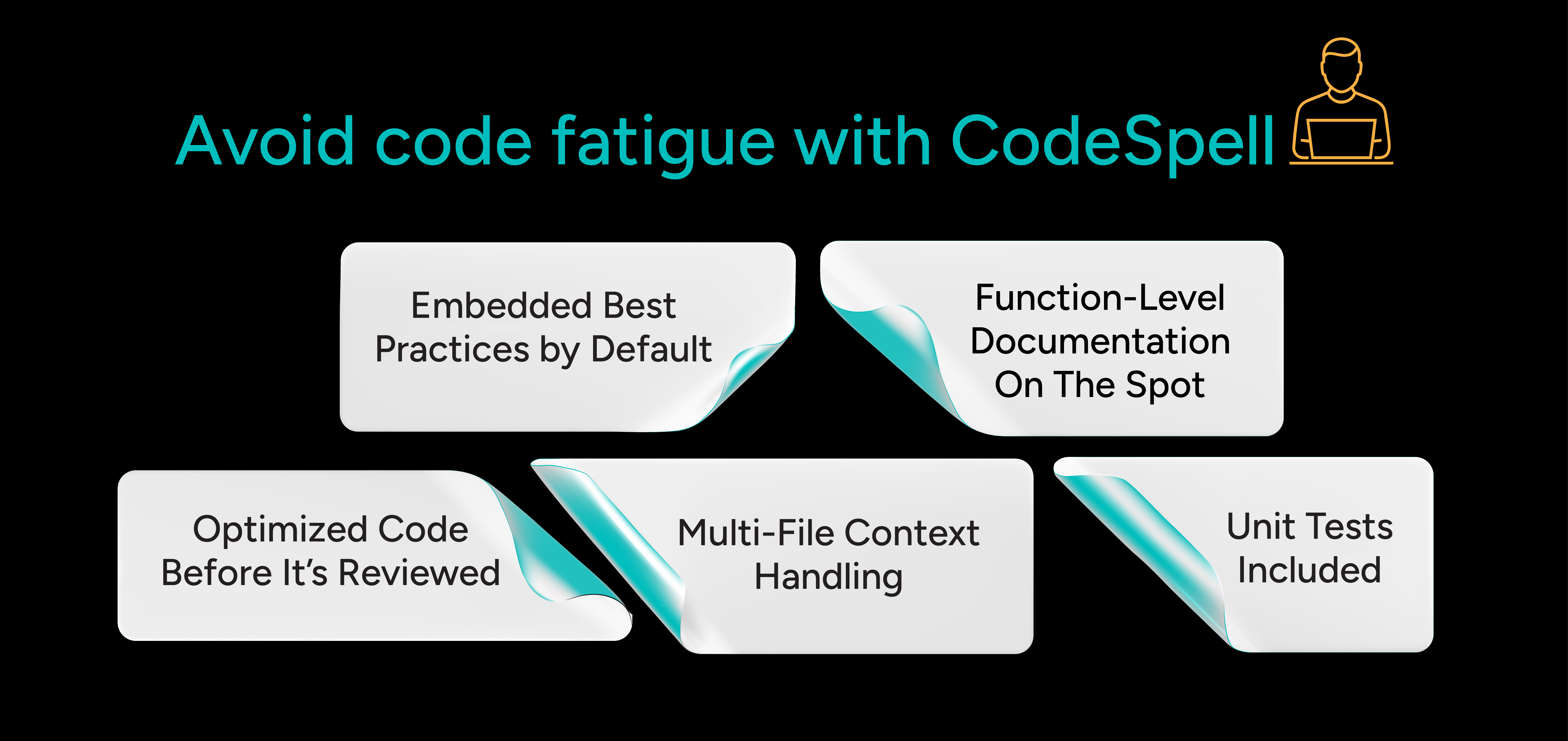
1. Embedded Best Practices by Default
CodeSpell doesn’t just generate code, it generates it based on predefined templates and organization-level best practices. This includes structure, naming conventions, error handling patterns, and more. Developers start with a high-quality base, reducing the need for reviewers to flag foundational issues.
2. Function-Level Documentation On The Spot
With a simple /doc spell or inline icon, developers can automatically generate detailed docstrings for their functions. This means reviewers don’t have to waste cycles asking, “What does this method do?” or “Can you explain the logic here?”
Documentation becomes a default part of the dev workflow and not a post-PR scramble.
3. Unit Tests Included
CodeSpell can auto-generate unit tests based on the function context. It selects the appropriate framework (e.g., Jest, JUnit, etc.), writes the test scaffolding, and ensures that every logic branch is accounted for. Reviewers no longer have to send the classic, “Please add tests” comment.
4. Optimized Code Before It’s Reviewed
Developers can use the /optimize spell or inline options to refactor long, messy functions into cleaner, modular code. This directly reduces reviewer effort and ensures that feedback focuses on business logic, not structural hygiene.
It’s especially useful for junior developers, enabling them to submit production-grade code confidently.
5. Multi-File Context Handling
One of the biggest challenges for reviewers is lack of context. CodeSpell allows developers to bring in multiple files (controllers, services, models) while asking the assistant for suggestions or documentation. This ensures the resulting code and any generated doc or test, it is context-aware and coherent.
The reviewer doesn’t have to jump between files to piece things together.
Resulting in More Focused Reviews
When CodeSpell is embedded in the team’s IDEs:
For CTOs, this translates to faster delivery, happier teams, and lower risk.



February 2, 2026
Don’t Miss Out
We share cool stuff about coding, AI, and making dev life easier.
Hop on the list - we’ll keep it chill.
© 2026, CodeSpell.ai. All Rights Reserved
.png)


