


Changelog
February 2, 2026

.png)
CodeSpell helps enterprise engineering teams drastically improve test coverage by generating unit and functional test scripts automatically. Using OpenAPI specifications or live code context, developers and QA engineers can generate framework-aligned, production-grade tests inside their IDE. This accelerates release cycles, reduces bugs, and lowers manual testing effort, enabling more confident deployments.
Enterprise software development is complex and so is testing it. As systems scale, ensuring test coverage across microservices, APIs, business logic, and UI flows becomes a monumental task. Yet, many teams still rely on manual processes to write and maintain test scripts.
The result is often the same:
Manual test creation is time-consuming and error prone. Across multiple services, this leads to inconsistent test quality and delays in testing readiness. It also places a heavy load on developers who may already be balancing sprint tasks and reviews.
Most critically, test coverage is often reactive written only after bugs are found, or when QA has time. This makes test strategy vulnerable to resource constraints and shifting priorities.
How CodeSpell Improves Test Coverage with AI-Generated Scripts
Test coverage often suffers when writing tests becomes a bottleneck. CodeSpell removes this friction by embedding AI-powered test generation directly into the developer and QA workflows. Whether it’s unit-level testing or API-level functional testing, CodeSpell helps teams improve test quality without slowing down development.
Unit Tests are Generated Instantly Inside the IDE
Within supported IDEs like Visual Studio Code and IntelliJ, developers can generate unit tests using the /unit-test spell or inline icons. CodeSpell analyzes the selected function’s logic, inputs, and context, and produces test cases aligned with the correct framework, such as JUnit or Jest.
These tests simulate real usage scenarios and include logical assertions, making them ready to plug into the team’s test suite. This reduces the risk of untested code making it into production, especially in high-velocity sprints.
API-Level Testing Through Test Script Studio
For larger services and integration-level testing, CodeSpell supports full-scale test generation from API specifications. QA teams or senior engineers can upload OpenAPI specs or Excel-based test case files. CodeSpell then generates structured, reusable test scripts using supported frameworks like REST Assured.
These scripts are production-ready, configurable for multiple environments, and easily integrated into CI/CD pipelines eliminating the need to write tests from scratch for every new endpoint.
Accelerating Coverage and Reducing Risk
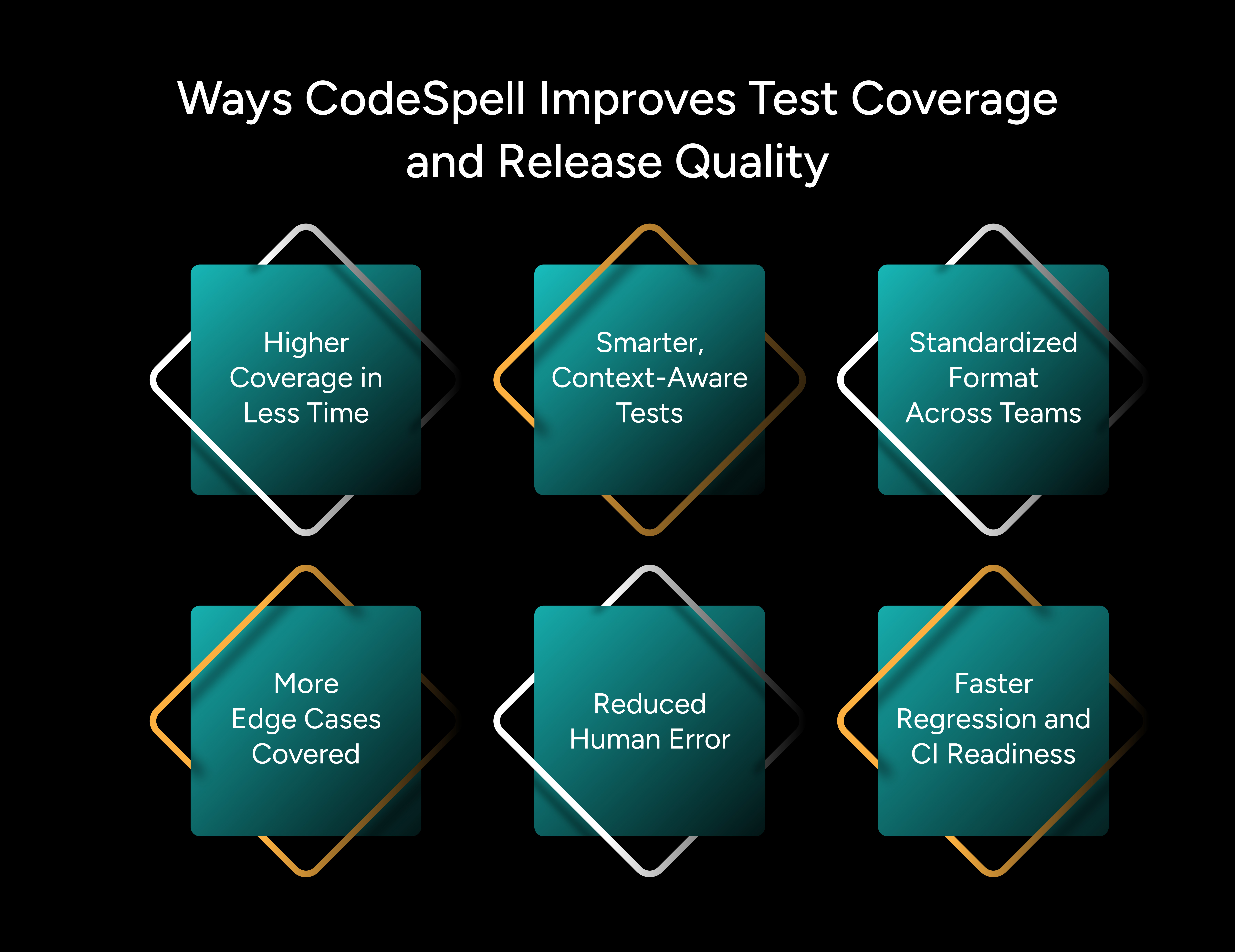
By automating both unit and API test creation, CodeSpell significantly improves overall test coverage. The platform ensures:
This means fewer defects in QA and production, reduced reliance on manual scripting, and more confidence in every release.
The biggest shift CodeSpell enables is moving testing earlier in the development cycle without burdening developers or over-extending QA.
Instead of writing tests after features are built, CodeSpell enables teams to:
With repeatable, AI-generated tests, teams gain confidence that what ships to users is tested, stable, and aligned to business requirements.



February 2, 2026
Don’t Miss Out
We share cool stuff about coding, AI, and making dev life easier.
Hop on the list - we’ll keep it chill.
© 2026, CodeSpell.ai. All Rights Reserved
.png)


