


Changelog
February 2, 2026

.png)
TL;DR
Code hygiene breakdown is a major contributor to technical debt in large engineering teams. Inconsistent structure, poor documentation, and missing tests create friction during reviews and increase long-term maintenance costs. CodeSpell eliminates this by automating hygiene at the source inside the developer’s IDE. From structured code generation to inline documentation, unit test creation, and context-aware suggestions, CodeSpell proactively enforces hygiene before code ever reaches a reviewer.
In theory, code reviews should catch most hygiene issues. In reality, reviewers are often overloaded. They scan for logic errors, business context, and test coverage, but can’t afford to dive deep into every stylistic or structural concern. Even when they do, their comments are often repetitive:
Over time, this drains reviewer energy and leads to inconsistent feedback. Developers may apply fixes in one PR but forget in the next. Review cycles stretch longer. Frustration builds.
CodeSpell approaches the problem differently. Instead of checking hygiene after code is written, it helps developers write clean code from the start. Everything happens inside the IDE the developer already uses, no separate toolchains or external processes.
At its core, CodeSpell combines AI-powered code assistance with a set of structured automation tools designed to enforce code hygiene across the entire SDLC.
Let’s explore how this works in practice.
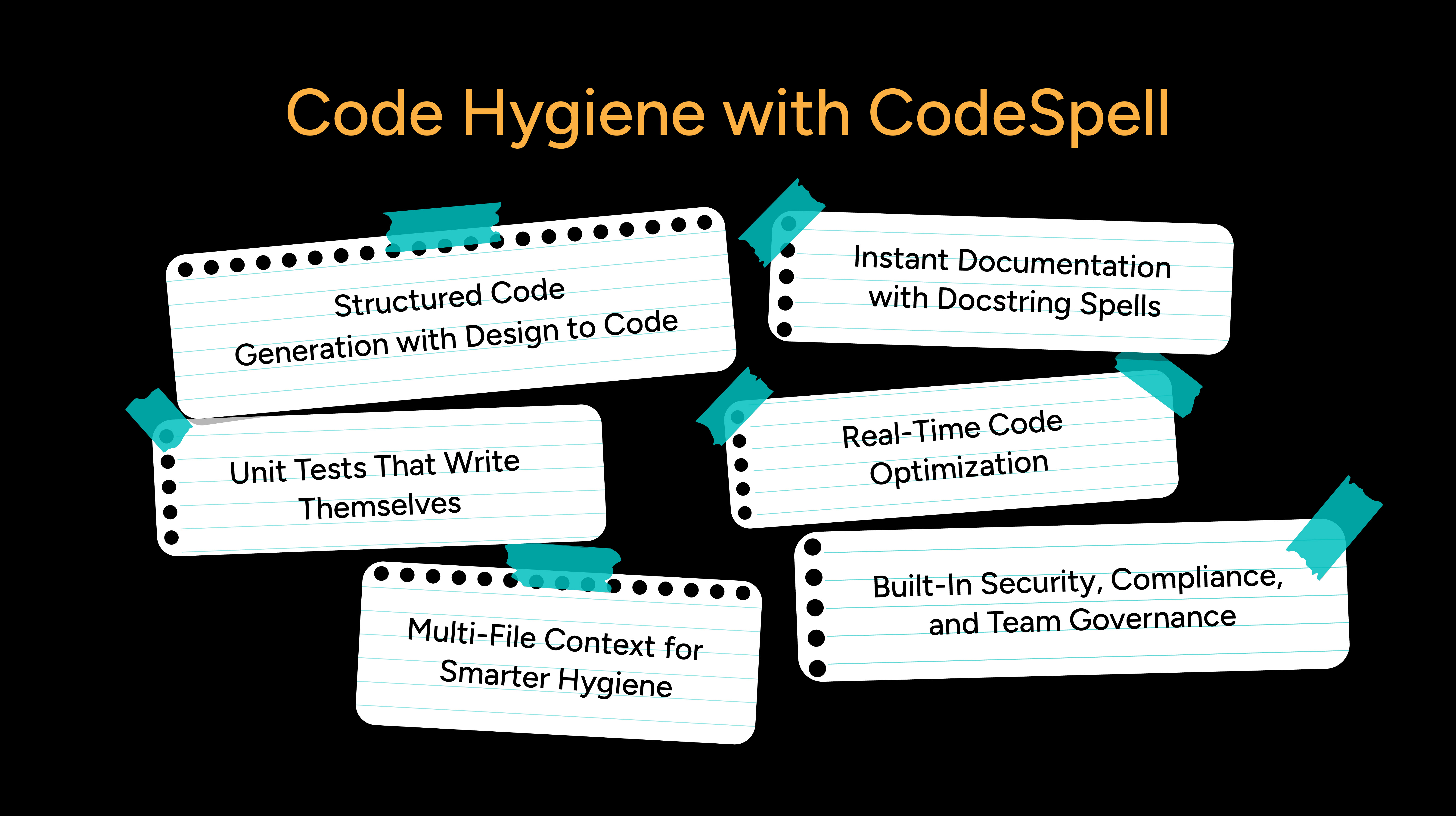
CodeSpell’s Design to Code automates backend code generation based on your application’s data model. Engineers can import a database schema or create one within the tool. CodeSpell then auto-generates:
This ensures every project starts with a consistent, production-ready foundation. No more inconsistently structured folders or mismatched naming conventions. The generated code adheres to architectural standards from day one.
One of the most overlooked hygiene issues is missing documentation. Developers often skip docstrings when rushing toward deadlines. Reviewers then request them post-hoc, adding unnecessary friction.
With CodeSpell, documentation is built in. A developer can simply highlight a function and trigger the /doc spell or click the inline documentation icon. CodeSpell will automatically generate a clear, framework-aligned docstring describing the method's purpose, parameters, return values, and edge cases.
Code hygiene includes verifying that code works as expected. Yet, developers often delay writing tests or skip them entirely. CodeSpell’s test generation feature addresses this.
By selecting a function and applying the /unit-test spell, developers get an automatically generated unit test that matches the logic of their code. CodeSpell identifies the right framework (e.g., Jest for JS, JUnit for Java), mocks dependencies, and generates a test file with coverage for expected behaviours.
Bloated functions and duplicated logic are another common hygiene concern. They aren’t always wrong, but they make code harder to read and maintain.
CodeSpell’s /optimize spell or inline “Optimize” button allows developers to automatically refactor long or inefficient functions. It suggests clearer variable names, extracts reusable logic into helper functions, and simplifies nested conditions.
This helps developers learn better structure while keeping reviewers focused on high-value feedback, not code style debates.
Many code hygiene issues aren’t visible in a single file. Poor variable reuse, missing validation, or logic duplication across services can be hard to spot.
CodeSpell allows developers to bring multiple files, like a controller, service, and model, into a shared context before generating code or explanations. This means hygiene isn’t enforced in isolation. It’s enforced across modules that work together.
Code hygiene also includes adherence to security and compliance standards. CodeSpell supports:
This allows engineering leaders to control who can generate or modify code, track usage, and ensure that all generated code complies with internal and industry regulations.
When CodeSpell is used consistently across an engineering team, the effects compound:
What used to require tribal knowledge or constant vigilance is now automated with standards enforced at the point of creation.



February 2, 2026
Don’t Miss Out
We share cool stuff about coding, AI, and making dev life easier.
Hop on the list - we’ll keep it chill.
© 2026, CodeSpell.ai. All Rights Reserved
.png)


