


Changelog
February 2, 2026

.png)
What if one small bug could break weeks of hard work?
That fear is real for modern product teams. Today, quality assurance is no longer a final step. It is part of everyday engineering. Fast releases and complex systems demand smarter testing tools. Teams now need tools that match their speed.
Here is what teams face today:
This shift has changed how QA tools are built. Modern platforms automate testing and fit into dev pipelines.
This blog explores the top 12 QA tools developers should try in 2026 to ship faster without breaking trust.
Modern QA tools in 2026 continue to evolve. They support faster release cycles and handle growing system complexity.
Key characteristics defining modern QA tools in 2026 include:
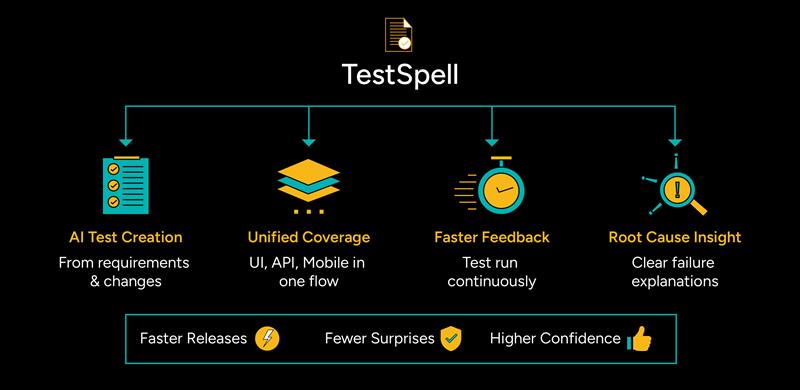
TestSpell, from SoftSpell, is an enterprise favourite as it represents where QA tools are headed; instead of treating testing as a separate phase, TestSpell integrates AI-driven testing into the SDLC. It supports automated test case generation, end-to-end coverage across layers, faster feedback loops, and root cause analysis to help teams understand failures, not just detect them.
For developers, this means:
TestSpell stands out in 2026 because it treats testing as a continuous, AI-assisted capability rather than a separate QA phase. By integrating directly into the SDLC and CI/CD pipelines, it enables teams to generate and maintain tests automatically while receiving faster, more actionable feedback.
Its focus on end-to-end coverage and root cause analysis helps developers spend less time managing tests and more time resolving real issues.
For teams operating at scale, TestSpell reduces manual effort without compromising quality, making it a strong indicator of where modern QA tooling is headed.
Selenium is a widely used QA tool due to its open-source nature and extensive ecosystem. It supports multiple browsers as well as programming languages, making it a common foundation for custom automation frameworks.
While it requires more setup and maintenance compared to newer tools, Selenium’s flexibility ensures it will continue to be relevant in 2026, especially for teams with strong automation expertise.
Microsoft RSAT (Regression Suite Automation Tool) is designed for testing Dynamics 365 applications. It enables functional regression testing in ERP environments where stability and compliance are critical.
Its scope is intentionally narrow, but within that scope, RSAT remains an important tool for enterprise teams working deeply within the Microsoft ecosystem.
Cypress is known for its fast execution and tight feedback loop during UI testing. It runs directly in the browser, giving developers real-time visibility into test behavior.
While Cypress excels at frontend testing, it is less suited for complex, multi-layer enterprise scenarios. Still, for web-focused teams, it remains a strong choice in 2026.
Playwright has gained popularity as a modern alternative to Selenium. It supports multiple browsers out of the box and works well with CI/CD pipelines.
Its growing ecosystem and language support make it appealing for developers who want cross-browser reliability with less configuration overhead.
LambdaTest provides cloud-based access to a large matrix of browsers and devices. It integrates with popular automation frameworks and supports parallel execution.
For distributed teams or those without local infrastructure, LambdaTest remains a practical choice for validating compatibility across environments.
Katalon offers a unified platform that supports web, API, mobile, and desktop testing. It appeals to teams that want both ease of use and extensibility.
Its balance between low-code and full scripting makes it suitable for organizations with varying levels of automation maturity.
Tricentis Tosca is known for its model-based testing approach and strong presence in enterprise environments, particularly around SAP and large transactional systems.
It is typically adopted by organizations with complex testing needs and formal QA governance structures.
Eggplant focuses on model-based testing and uses AI to simulate real user journeys. It is often used in environments where understanding system behavior from an end-user perspective is critical.
Testim uses machine learning to improve test stability and reduce flakiness in UI automation. It is commonly adopted by teams that struggle with frequent UI changes breaking tests.
While primarily focused on UI automation, it reflects the broader trend of AI-assisted QA tools.
Tuskr simplifies test case management with an easy-to-use UI and powerful features. It allows seamless integrations with tools like issue trackers and automation frameworks. With AI-powered test case creation,
Tuskr saves time and boosts coverage. The platform provides real-time dashboards and in-depth test execution analytics, giving actionable insights. It also supports rich-text editing, image pasting, and custom fields for business-specific data, streamlining test case creation and optimization.
Autify accelerates the software testing lifecycle by partnering AI with human expertise. It simplifies the testing process, ensuring rapid software evolution without compromising quality. With easy-to-use tools,
Autify helps users get up to speed quickly. Its self-healing and flexible locators make maintenance hassle-free. Built for end-to-end (E2E) testing, Autify supports regression, smoke, functional, and visual testing, ensuring comprehensive coverage for all testing needs.
QA tooling in 2026 is defined by integration, automation, and intelligence. While established tools like Selenium and Cypress continue to play important roles, platforms like TestSpell show how testing is evolving into a continuous, AI-assisted part of software delivery.




February 2, 2026
Don’t Miss Out
We share cool stuff about coding, AI, and making dev life easier.
Hop on the list - we’ll keep it chill.
© 2026, CodeSpell.ai. All Rights Reserved
.png)


