


Changelog
February 2, 2026

.png)
TL;DR
A zero-touch sprint is a way of managing software delivery where routine SDLC work is automated to reduce manual handoffs and execution drag. It shifts teams away from coordination-heavy sprints toward predictable, outcome-driven delivery. The focus is on removing friction across requirements, development, testing, and release readiness while keeping humans in control of decisions.
Even strong agile teams run into the same structural friction. Requirements arrive scattered across documents and tickets. Engineers spend time rebuilding boilerplate instead of building differentiators. QA becomes the place where ambiguity is finally exposed. Release readiness depends on late-stage coordination.
These are not isolated inefficiencies; they are repeatable touchpoints that introduce delay and uncertainty sprint after sprint.
A zero-touch sprint is a leadership response to this reality. It reflects a shift away from optimizing sprints through more meetings and process alone, toward reducing execution drag by automating work that should never have been manual in the first place.
A zero-touch sprint becomes easier to understand when you map it to sprint phases and ask a simple question: where do humans add judgment, and where are they simply moving work from one place to another?
CodeSpell is relevant in the second category, removing manual movement and repetitive effort so teams can stay focused on decisions that actually require human input.
Sprints often start to go wrong when requirements are unclear, inconsistent, or spread across multiple sources. In a zero-touch model, teams begin with structured requirements that can be queried, traced, and validated early, rather than rediscovered mid-sprint.
ReqSpell is designed for this purpose. It extracts and organizes requirements from unstructured sources such as product documents, spreadsheets, test plans, and legacy codebases. It also supports cross-team alignment by making these inputs searchable through natural language queries, for example, identifying functional requirements for a module or understanding which tests cover a specific edge case.
The result is fewer clarification cycles during the sprint and planning discussions focused on priorities rather than interpretation.
Most sprint time is not spent on hard engineering. It is spent on necessary but repetitive tasks, such as understanding existing functions, writing documentation, generating unit tests, and cleaning up complexity.
CodeSpell’s in-IDE assistant reduces this friction through built-in spells that keep developers in flow:
For enterprise leaders, this matters because it reduces dependency on tribal knowledge. When teams can understand and improve code more easily, delivery becomes less fragile and onboarding becomes smoother.
Sprints often fail late. Tests do not exist, coverage is unclear, or failures surface too close to release.
TestSpell is designed to pull testing earlier by converting requirements, user stories, or Jira inputs into test cases and supporting execution with reporting and root cause analysis. This allows teams to understand why tests fail, not just that they fail. The difference is operational, moving from hoping quality holds to continuously validating it throughout the sprint.
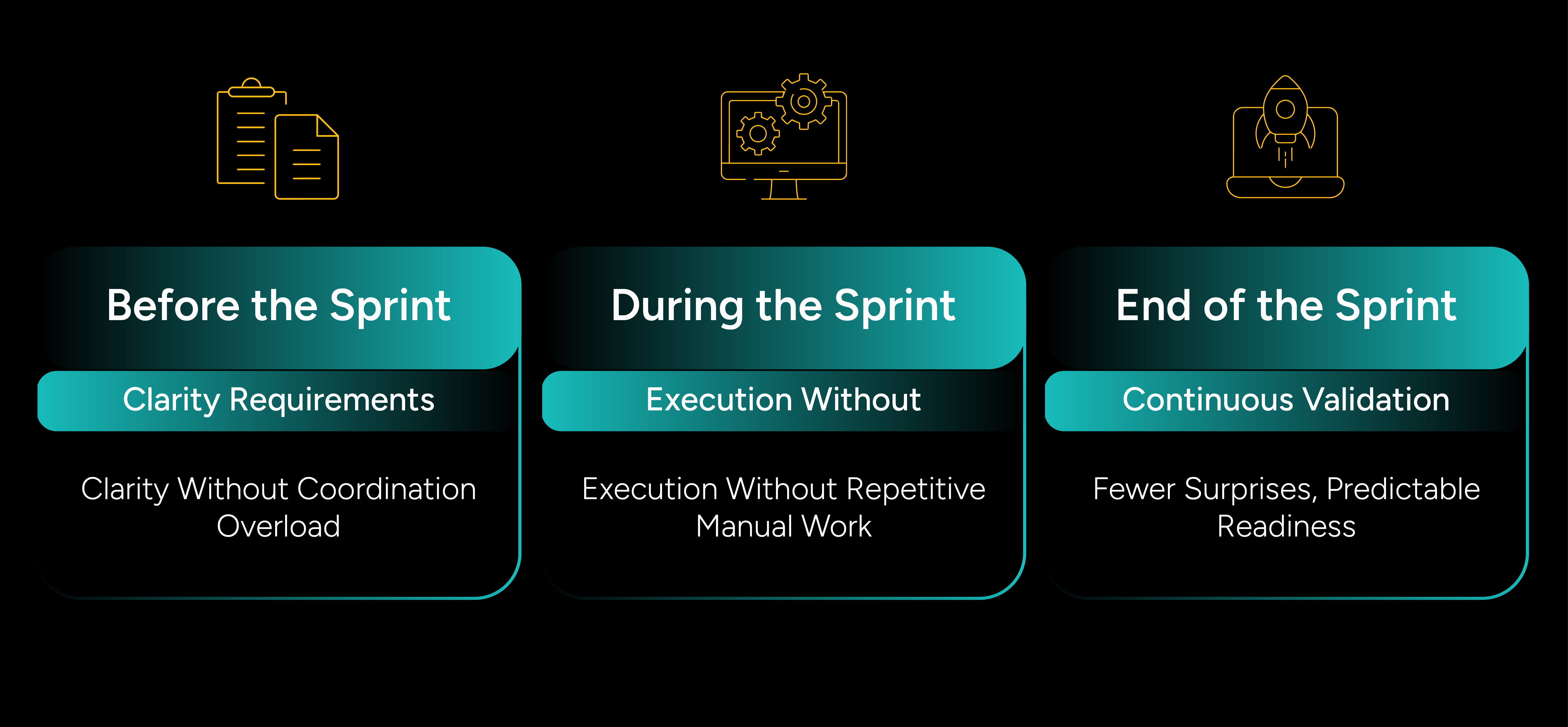
For CTOs and enterprise leaders, the goal is not to add AI. The goal is to reduce sprint drag without sacrificing governance or control.
A pragmatic path looks like this:
A zero-touch sprint is ultimately an executive outcome: fewer delays, fewer surprises, and less operational drag. When requirements are structured early, coding is accelerated in flow, and testing runs in parallel with development, the sprint stops behaving like a chain of handoffs and starts operating as a predictable delivery system.
The real promise here is not “move fast and break things.” It is move fast and know what you are shipping.



February 2, 2026
Don’t Miss Out
We share cool stuff about coding, AI, and making dev life easier.
Hop on the list - we’ll keep it chill.
© 2026, CodeSpell.ai. All Rights Reserved
.png)


