
AI Code
January 20, 2026

.png)
As organizations close the year, engineering leaders are reevaluating requirement processes, delivery predictability, and cross-functional alignment. Many teams delivered aggressively, but execution gaps often emerged due to fragmented requirement documentation and inconsistent communication. This year-end reflection is pushing CTOs to adopt enterprise-grade requirement management software that strengthens clarity, traceability, and governance.
ReqSpell is emerging as a strategic system for enterprises that want a structured, automated, and scalable approach to managing requirements across the engineering lifecycle.
Enterprise requirement management is the process of defining, documenting, reviewing, tracking, and validating requirements across product, engineering, and QA teams. It ensures that every requirement is understood consistently, executed correctly, and validated precisely.
Modern organizations are replacing spreadsheets and standalone documents with a unified requirement management tool because they need:
• Predictable delivery
• Reliable handoffs
• Audit-ready documentation
• Traceability across requirements, code, and tests
ReqSpell supports these needs with an integrated approach to requirement capture, analysis, and lifecycle governance.
Requirement drift happens when different teams interpret requirements differently. As engineering organizations scale, this drift creates operational inefficiencies and quality issues.
Common year-end findings across enterprises include:
• Rework and extended development cycles
• QA delays caused by unclear acceptance criteria
• Ambiguous BRD and SRS documentation
• Misaligned expectations across product, engineering, and QA
• Missed release deadlines due to unclear scope
ReqSpell reduces requirement drift through structured templates, automated clarification, and version-controlled documentation that remains consistent throughout the lifecycle.
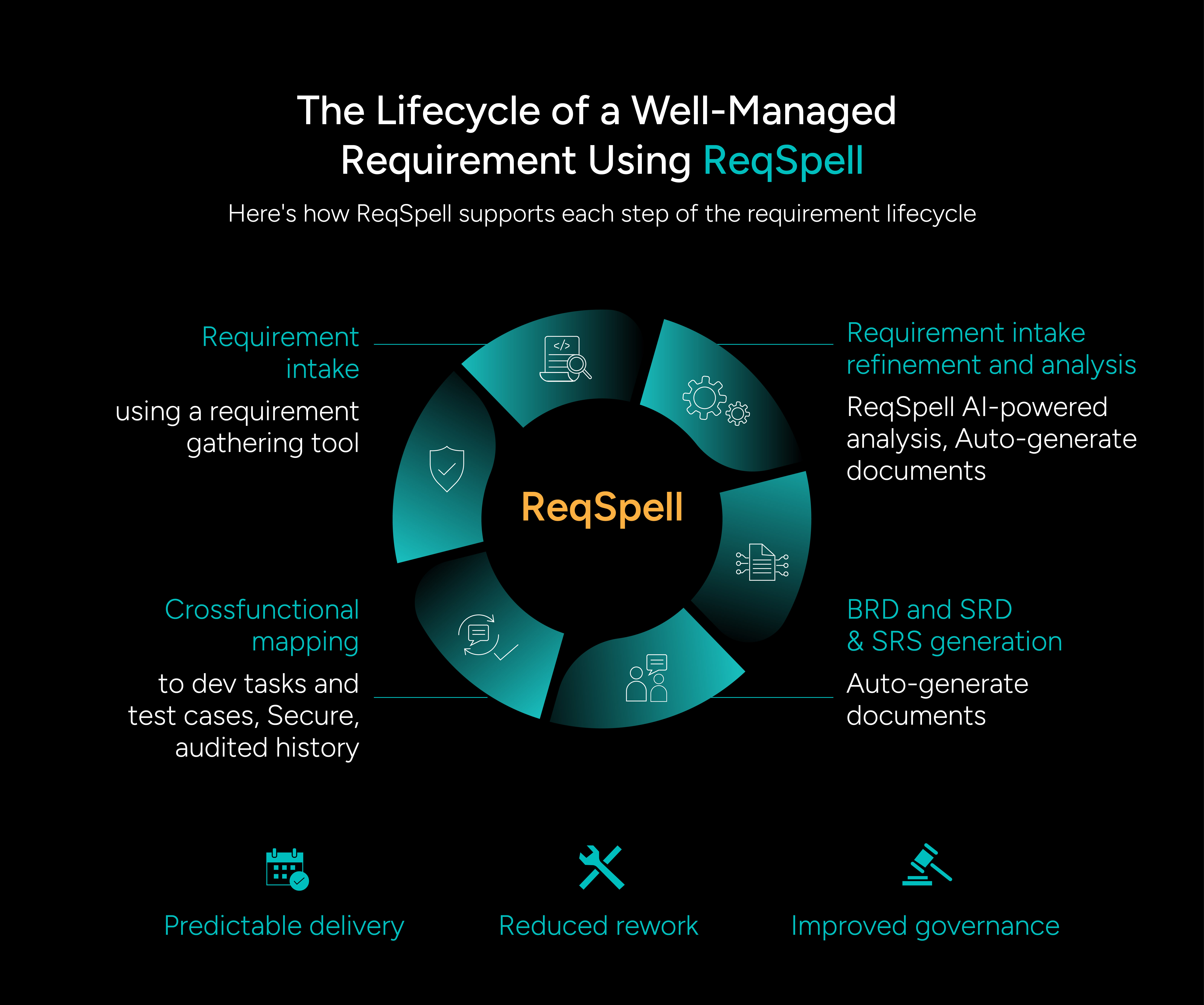
Engineering leaders are investing in requirement management tools to improve predictability and eliminate last-minute escalations. During year-end tool evaluations, several capabilities emerge as essential.
Key priorities include:
• End-to-end traceability across requirements, development, and testing
• AI-driven requirement refinement for clarity and completeness
• Centralized BRD software for approvals and stakeholder alignment
• SRS documentation tool features that eliminate manual formatting
• Automated impact analysis for requirement updates
• Enterprise governance with reliable audit trails
ReqSpell enables each of these priorities by providing an integrated environment where teams can collaborate and execute without ambiguity.
Most enterprise teams struggle with inconsistent BRDs and SRS documents. Formatting varies by team. Terminology differs across squads. Approvals take time. Updates lack traceability.
ReqSpell solves these gaps with:
• BRD and SRS templates aligned to enterprise expectations
• Automated structuring for requirement clarity
• Review and approval workflows with real-time visibility
• Version control for every modification
• Clear linkage between requirements and downstream test scenarios
This gives engineering leaders confidence that documentation quality remains consistent across the organization.
Agile environments generate continuous change. Requirements evolve across sprints, and teams need a system that can support rapid iteration without losing control.
ReqSpell supports agile practices through:
• Dynamic requirement updates
• Backlog refinement assistance
• Support for epics, user stories, and acceptance criteria
• Clear traceability between requirements, tasks, and tests
• Faster stakeholder alignment across sprint cycles
This ensures that agile teams maintain discipline even in high-velocity environments.
The best requirement management tool for enterprises is one that offers clarity, traceability, automation, and governance readiness. ReqSpell meets these criteria by centralizing requirement workflows, improving documentation quality, and reducing manual effort. It is designed specifically for large-scale engineering teams that need a reliable and systematic requirement process.
Engineering leaders switch requirement management tools at year-end because this is the period when teams review performance, analyze delivery bottlenecks, and approve new systems for the next planning cycle. Year-end reviews make inefficiencies clear, such as requirement drift, documentation inconsistencies, and lack of traceability. Tools like ReqSpell help eliminate these issues before the next annual roadmap begins.
CTOs are moving toward standardization because fragmented processes increase operational risk. ReqSpell strengthens governance by providing:
• A consistent source of truth across squads
• Structured requirement workflows
• Transparent change tracking
• Reliable audit trails
• Improved compliance readiness
• Coverage visibility across requirements and test scenarios
These capabilities form the foundation of an enterprise-ready requirement management system.
As engineering complexity grows, organizations need systems that reduce ambiguity and increase predictability. ReqSpell enables leaders to enter 2026 with stronger control, better alignment, and improved delivery assurance.
Enterprises adopting ReqSpell gain:
• Faster requirement reviews
• Better cross-functional alignment
• Reduction in rework and misinterpretation
• Higher quality releases
• Scalable processes across teams and product lines
ReqSpell positions engineering leaders to operate with precision, even in fast-changing delivery environments.


Don’t Miss Out
We share cool stuff about coding, AI, and making dev life easier.
Hop on the list - we’ll keep it chill.
© 2026, CodeSpell.ai. All Rights Reserved