


.png)
Figma to code
January 29, 2026

.png)
TL;DR
In large codebases, developers spend more time understanding existing systems than writing new code. This cognitive load slows delivery, increases risk, and creates dependency on tribal knowledge. Reducing it requires surfacing intent and context during development, not after. Context-aware AI, used inside the developer workflow, helps teams manage complexity without hiding it.
As software systems grow, complexity shifts from code volume to mental overhead. Developers working in large codebases must understand not just what the code does, but why it exists, how it evolved, and what depends on it. Even small changes can require navigating multiple files, services, and historical decisions.
This cognitive load accumulates over time. Documentation becomes outdated. Architectural intent is not always visible in code. Knowledge concentrates with a few long-tenured engineers. New team members take longer to onboard, and experienced developers become unintentional bottlenecks.
The result is slower progress, uneven productivity, and higher risk of mistakes, not because teams lack skill, but because understanding the system consumes most of their attention.
Reducing cognitive load does not mean hiding complexity or removing responsibility from developers. Engineers still need to understand systems well enough to make sound decisions. What matters is reducing avoidable mental effort.
In practice, this means:
This is where CodeSpell becomes useful not as a code generator, but as a support system for understanding. When CodeSpell operates with awareness of files, workspace structure, and surrounding context, it can help developers reason about code more effectively. The goal is not to replace thinking, but to reduce the mental overhead required to reach clarity.
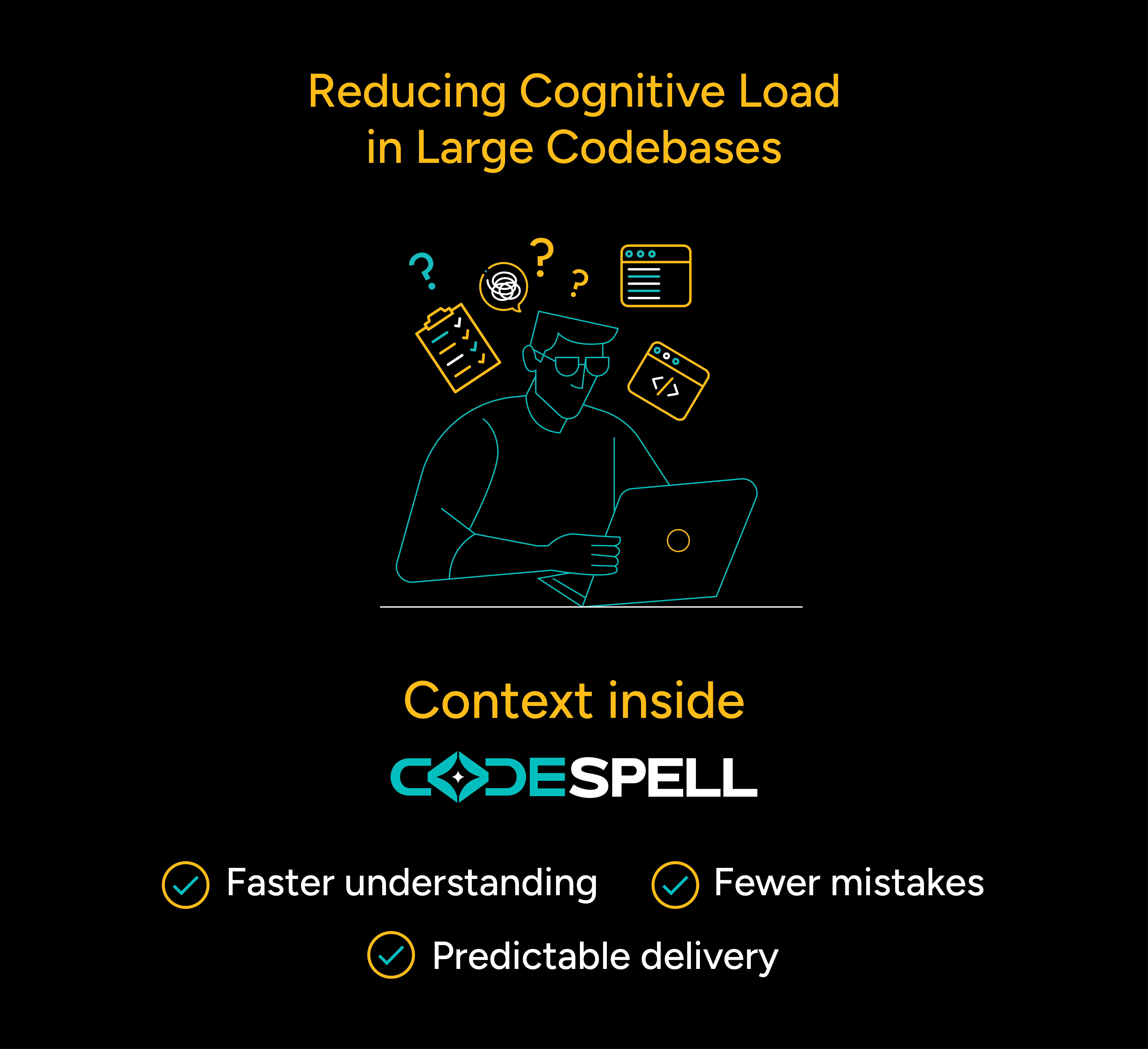
The most effective way to reduce cognitive load is to bring context directly into the developer workflow, where decisions are made. In software development, that place is the IDE.
CodeSpell is designed around this principle. By operating inside the IDE and working with file- and workspace-level awareness, it helps developers access relevant context without breaking flow. Developers can understand unfamiliar code more quickly, document intent as they work, and reason about behavior and quality without constantly switching tools.
This approach reduces reliance on tribal knowledge and lowers the mental cost of working in unfamiliar parts of a large codebase. Importantly, developers remain fully in control. AI suggestions are reviewed, adapted, and applied by humans, ensuring that judgment and accountability stay where they belong.
When cognitive load is reduced, teams see benefits that go beyond individual productivity. Onboarding becomes faster because systems are easier to understand. Code reviews focus more on design decisions and correctness, rather than explanations of intent. Fewer issues are introduced due to misunderstood context.
Over time, delivery becomes more predictable. Knowledge is embedded in workflows rather than locked in individuals. Teams scale more smoothly because understanding the system no longer depends on a small group of experts.
Reducing cognitive load is not a short-term optimization. It is a foundation for sustainable engineering in large, long-lived systems.
Large codebases are inevitable in successful organizations. The challenge is not eliminating complexity but managing it in a way that allows teams to keep moving forward.
By reducing cognitive load through better access to context and in-workflow support, teams can build systems that remain understandable, adaptable, and resilient as they grow. Context-aware AI, used responsibly, helps shift engineering from constant reconstruction to confident execution.
This is how organizations move from overloaded developers to sustainable engineering systems.



Don’t Miss Out
We share cool stuff about coding, AI, and making dev life easier.
Hop on the list - we’ll keep it chill.
© 2026, CodeSpell.ai. All Rights Reserved
.png)


