The 5 Most Expensive Gaps in Your SDLC (And How Codespell Can Close Them)

AI SDLC

November 29, 2025

Introduction

Even with CI/CD pipelines, agile practices and best-in-class tooling, software delivery still breaks down in surprising ways. The underlaying problem is most teams focus on optimizing the visible parts of the SDLC such as code, deployment, testing while ignoring the structural gaps that slow delivery, create rework, and erode quality.

These gaps embed into daily workflows and  cost more than most teams realize.

This blogs explores the five most expensive and persistent breakdowns across the modern SDLC and how CodeSpell close them.

1. Unstructured Requirements That Lead to Rework

The Problem

Requirements are still written in natural language which are ambiguous, incomplete, and open to interpretation. What looks clear in a product spec often triggers multiple follow-ups during development. This lack of structure leads to misalignment between product, engineering, and QA.

Business Impact

  • Increased rework mid-sprint
  • Wasted engineering cycles on clarification
  • Slower time to feature delivery

How CodeSpell Closes It

Requirement engine ReqSpell parses natural-language requirements and transforms them into structured, testable, engineering-ready specifications.  
It:

  • Extracts actors, flows, constraints, dependencies
  • Identifies missing technical details early
  • Links directly to test plans and downstream code

This ensures developers build from complete, validated specs eliminating ambiguity from the start.

2. Delayed Testing That Creates Late Risk

The Problem

In many organizations, QA still starts after development ends. Even with agile workflows, test planning and case creation often lag behind code, leaving little time for deep validation.

Business Impact

  • Bugs found late in the cycle
  • Costly fixes post-UAT
  • Release delays and unstable builds

How CodeSpell Closes It

TestSpell, the QA automation layer, solves this by generating tests as soon as requirements are validated.  
It:

  • Generates test cases from ReqSpell output or JIRA stories
  • Supports API, UI, and mobile flows
  • Executes tests in parallel with development
  • Provides real-time feedback and root cause analysis

This enables shift-left testing where QA starts early and moves fast.

3. Manual Handoffs Between Design, Code and Infra

The Problem

Design teams work in Figma. Frontend devs convert designs to code. Backend teams build APIs. Infra teams write Terraform. These handoffs are often manual, disconnected, and error prone.

Business Impact

  • Design-code drift
  • Redundant dev effort
  • Environment mismatches at deployment

How CodeSpell Closes It

CodeSpell automates this full transition from idea to deployment by:

Resulting in clean, consistent, and scalable code without redundant work.

4. Lack of Traceability from Requirement to Release

The Problem

When things go wrong in production, teams often can't trace failures back to specific business requirements. There’s no clear link between what was requested, what was built, and what was tested.

Business Impact

  • Audit risk in regulated industries
  • Slow root cause analysis
  • Inconsistent product outcomes

How CodeSpell Closes It

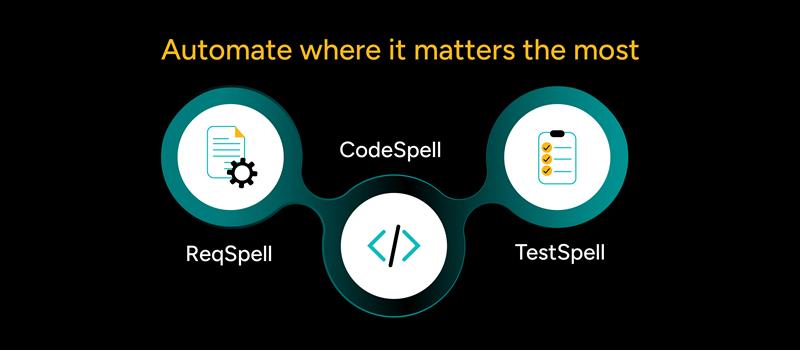
CodeSpell maintains a connected chain of custody across the SDLC:

  • ReqSpell defines the requirement
  • TestSpell validates the functionality
  • CodeSpell core generates the codebase
  • All artifacts are linked in a single traceability graph

This improves compliance, observability, and internal confidence.
5. Engineers Spending Time on Low-Value Work

The Problem

Even senior developers still spend hours on repetitive, boilerplate tasks, writing the same routes, stubs, validators, and documentation from scratch.

Business Impact

  • Reduced productivity and velocity
  • Burnout and disengagement
  • High cost of engineering time wasted

How CodeSpell Closes It

CodeSpell acts as a full-stack co-pilot that:

  • Auto-generates function-level code, routes, validations
  • Produces clean, documented boilerplate
  • Flags code smells and offer refactoring suggestions
  • Embeds inline assistance in your IDE

Your engineers spend less time on grunt work and more time solving real problems.

Bringing It Together: Closing the Gaps End-to-End

Each of these five gaps might seem small on its own but together, they create compounding inefficiencies that undermine delivery at scale.

By embedding AI across the full SDLC, CodeSpell ensures:

  • Requirements are clear, complete, and structured
  • Designs translate directly into code
  • Tests are ready before the first bug hits
  • Engineers write less boilerplate and more business logic
  • Releases are traceable, testable, and production-ready

Table of Contents

    FAQ's

    1. Can we use CodeSpell with JIRA and GitHub?
    Yes. ReqSpell integrates with JIRA and can extract testable requirements directly from epics or stories. TestSpell also syncs with GitHub Actions and other CI/CD tools.
    2. Is Codespell only for greenfield projects?
    Not at all. ReqSpell can reverse-engineer legacy codebases and extract requirement intelligence to modernize existing systems.
    3. How accurate is the requirement parsing?
    ReqSpell uses domain-trained AI models to identify dependencies, actors, constraints, and ambiguities in requirement text. It surfaces gaps for review, so teams stay in control.
    4. What languages and frameworks does CodeSpell support?
    CodeSpell supports React, Angular, Node.js, Python, and Java (with additional frameworks in roadmap). It’s designed to work with modern enterprise stacks.
    5. Can ReqSpell work with legacy documents and codebases?
    Yes. ReqSpell is designed to process legacy documentation, source code, spreadsheets, and test cases, transforming them into structured, searchable, and actionable requirements.
    Blog Author Image

    Full-stack marketer at Codespell, building growth strategies at the intersection of tech, content, and community. Sharing insights on marketing, automation, and the tools powering modern developer ecosystems.

    Don’t Miss Out
    We share cool stuff about coding, AI, and making dev life easier.
    Hop on the list - we’ll keep it chill.