


Changelog
February 2, 2026

.png)
Traditional software development models are slow, siloed and resource heavy. By 2026, forward-thinking enterprises will adopt AI-powered SDLCs that accelerate delivery, reduce cost and unify teams from design to deployment. CodeSpell is already leading this shift, enabling engineering teams to automate frontend, backend, testing and infrastructure setup from inside the IDE.
Despite advances in frameworks, cloud tooling and collaboration platforms, the core structure of software development hasn’t changed much in two decades. Most enterprise teams still follow a fragmented workflow:
As the result, it leads to longer cycles, inconsistent outputs, rising engineering costs, and lower team morale. In an era of rising UX expectations, multi-platform complexity, and tight budgets, this model is unsustainable.
2026 will mark the turning point, because of necessity and maturity of the tools that make end-to-end AI-assisted development feasible at scale.
1. Design-to-Code Acceleration
Frontend development is historically slowed by the handoff gap between design and code. Engineers interpret static mockups, build layouts manually, and align components to design systems by hand.
With CodeSpell’s Figma to Code capability, UI designs are converted into responsive, production-ready code for React, Angular, or React Native. Developers receive structured layouts, components, and styling aligned with enterprise design systems, instantly.
This reduces delays and ensures pixel-perfect implementation without rework.
2. AI-Driven Backend and API Generation
Setting up backend scaffolding, CRUD operations, service layers, controllers, validation, can consume 30–40% of initial sprint time. CodeSpell’s Design to Code lets teams generate this scaffolding directly from a database schema or configuration.
Supported languages include Node.js, Java, .NET, Golang, and PHP. Engineers select their tech stack, input or import their entity model, and CodeSpell generates backend code aligned to best practices.
So the projects start structured and consistent eliminating fragmented, ad-hoc backend setups.
3. Automated Test Script Creation
Functional test coverage is critical, but often delayed or skipped due to time constraints. Manual test creation is repetitive, especially when specs are already defined.
CodeSpell automates test generation using OpenAPI specs or Excel-based test cases. It produces test scripts with logging, assertions, and frameworks like REST Assured or Postman-ready output.
On the unit test side, developers can auto-generate tests directly from the IDE using the /unit-test spell. The assistant detects the context, identifies logic paths, and generates framework-aligned tests.
This enforces test hygiene while freeing QA and developers from repetitive work.
4. Infrastructure as Code Made Effortless
Cloud infrastructure setup remains one of the most manual and error-prone aspects of the SDLC. Even with Terraform or AWS CDK, teams must write configuration scripts, map environments, and manage dependencies.
CodeSpell’s Infrastructure Studio allows DevOps teams to configure cloud environments visually or via metadata. It then generates Terraform scripts for infrastructure including EC2, RDS, S3, and more.
This eliminates delays during deployment prep and ensures consistency across staging, QA, and production environments.
5. Hygiene, Documentation, and Optimization Built In
Code hygiene is often enforced inconsistently. Developers forget docstrings. Teams debate naming conventions. Long functions go unoptimized.
CodeSpell embeds best practices directly into the coding workflow.
So developers can:
This reduces the burden on reviewers and maintains code quality across large teams.
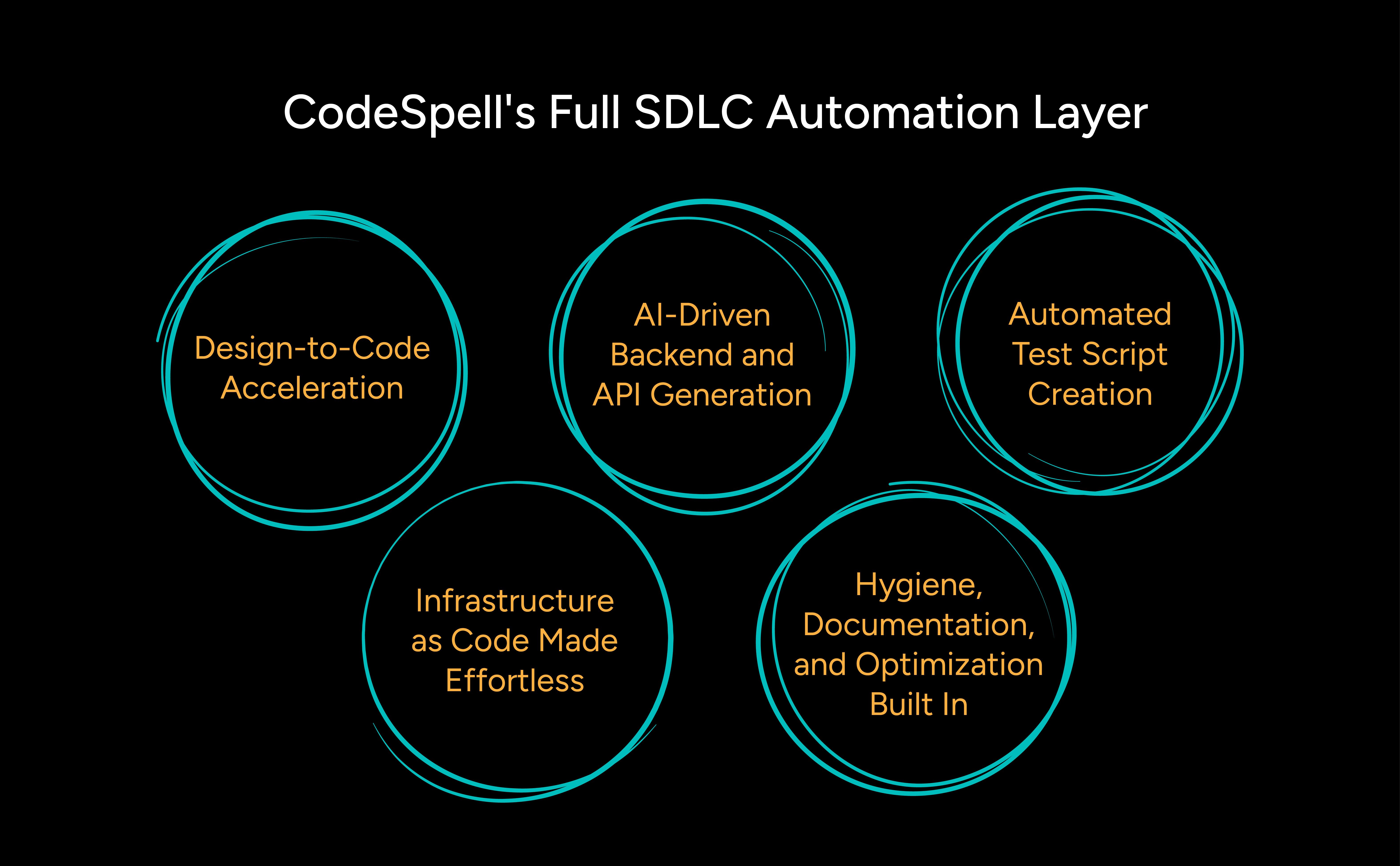
CodeSpell isn’t a collection of features, it’s an AI-powered SDLC copilot. It unifies design, code, testing, and infrastructure into a seamless, developer-first experience inside the IDE.
What makes it enterprise-ready:
For large engineering orgs, it acts as a shared brain across developers, QA, DevOps, and design ensuring consistency, velocity, and fewer bottlenecks.



February 2, 2026
Don’t Miss Out
We share cool stuff about coding, AI, and making dev life easier.
Hop on the list - we’ll keep it chill.
© 2026, CodeSpell.ai. All Rights Reserved
.png)


